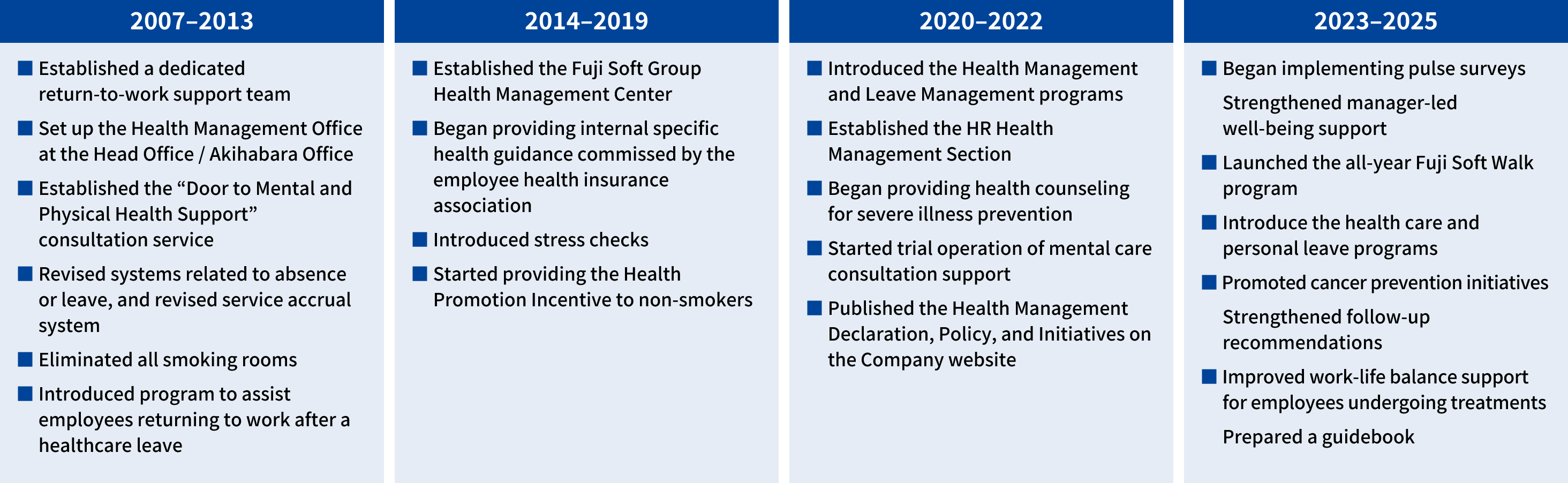
Health Management
Health Management Policy
Health management policy
Guided by a fundamental belief that “a company is its people,” Fuji Soft’s health management aims to provide a working environment where employees and their families are assured the work conditions are psychologically and physically healthy and safe.
Mitsuhiro Murooka
Representative Director, President and CEO

Health Management Structure
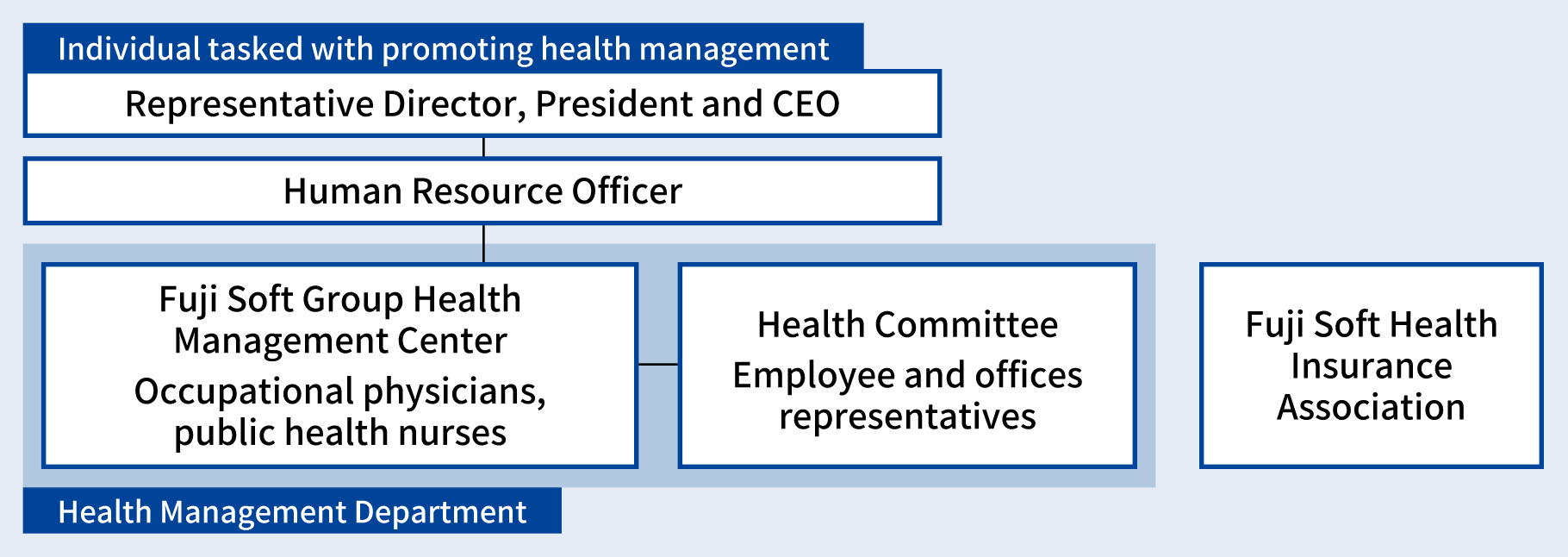
Fuji Soft Group Health Management Center
Healthcare rooms were established at our head office and main offices in 2007 to oversee and manage occupational health activities across all worksites. We later consolidated Group health management operations at the Fuji Soft Group Health Management Center in 2014, extending healthcare services to all Group employees while ensuring a consistent level of care throughout the organization.
Health Management Initiatives
Health management is promoted through the following measures, which are supported by setting target indicators.
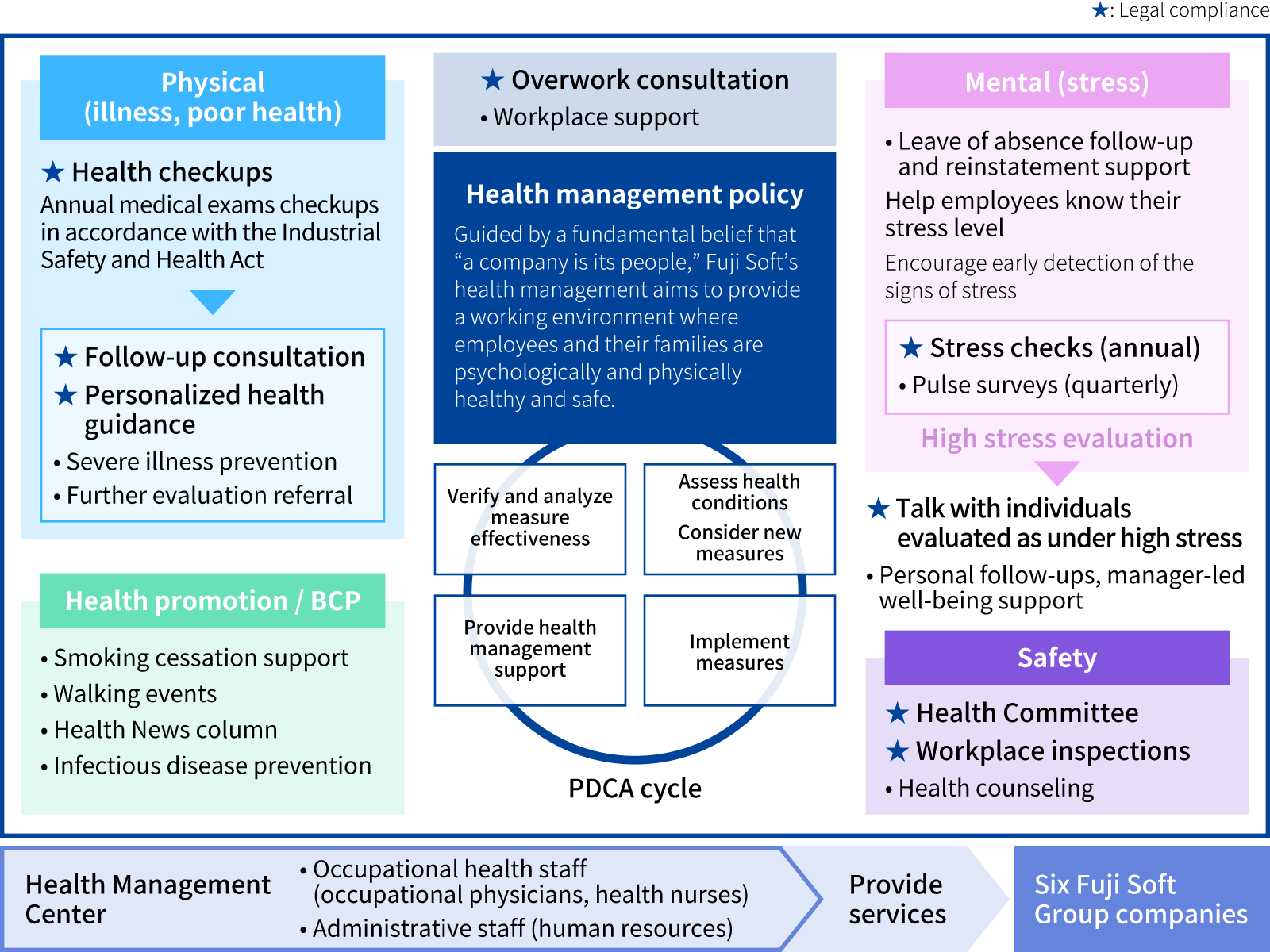
Health indicators
The Company actively promotes the maintenance of health for its employees and their families through regular health checkups to promote early detection and intervention and through follow-up support. We also seek to raise employee health awareness and cultivate health literacy through health education programs and a regular health column presenting seasonal themes and content for younger employees.
We place particular emphasis on preventing high-risk health conditions by increasing participation in the health checkups and helping to improve checkup outcomes by recommending follow-up examinations. On-site public health nurses offer individualized health advice and support to help employees improve their health.
| Item | Measurement method | FY2022 | FY2023 | FY2024 | FY2025 (Target) |
|---|---|---|---|---|---|
| Health checkup participation | Percentage of employees participating in health checkups | 99.2% | 99.4% | 100.0% | 100.0% |
| Health issue detection | Percentage of employees whose health checkups identified a potential health issue | 59.5% | 55.7% | 55.6% | 55.5% |
| Guidance for follow-up testing | Percentage of employees provided guidance for follow-up examinations at detailed examinations | 75.1% | 70.3% | 91.9% | 92.0% |
| Health improvement after guidance | Percentage of employees whose checkup results improved after receiving guidance in the previous year | 39.9% | 42.5% | 49.3% (Forecast) |
50.0% |
Regular exercise
Percentage of health survey respondents indicating they have done 30 minutes of light exercise twice or more a week for over a year
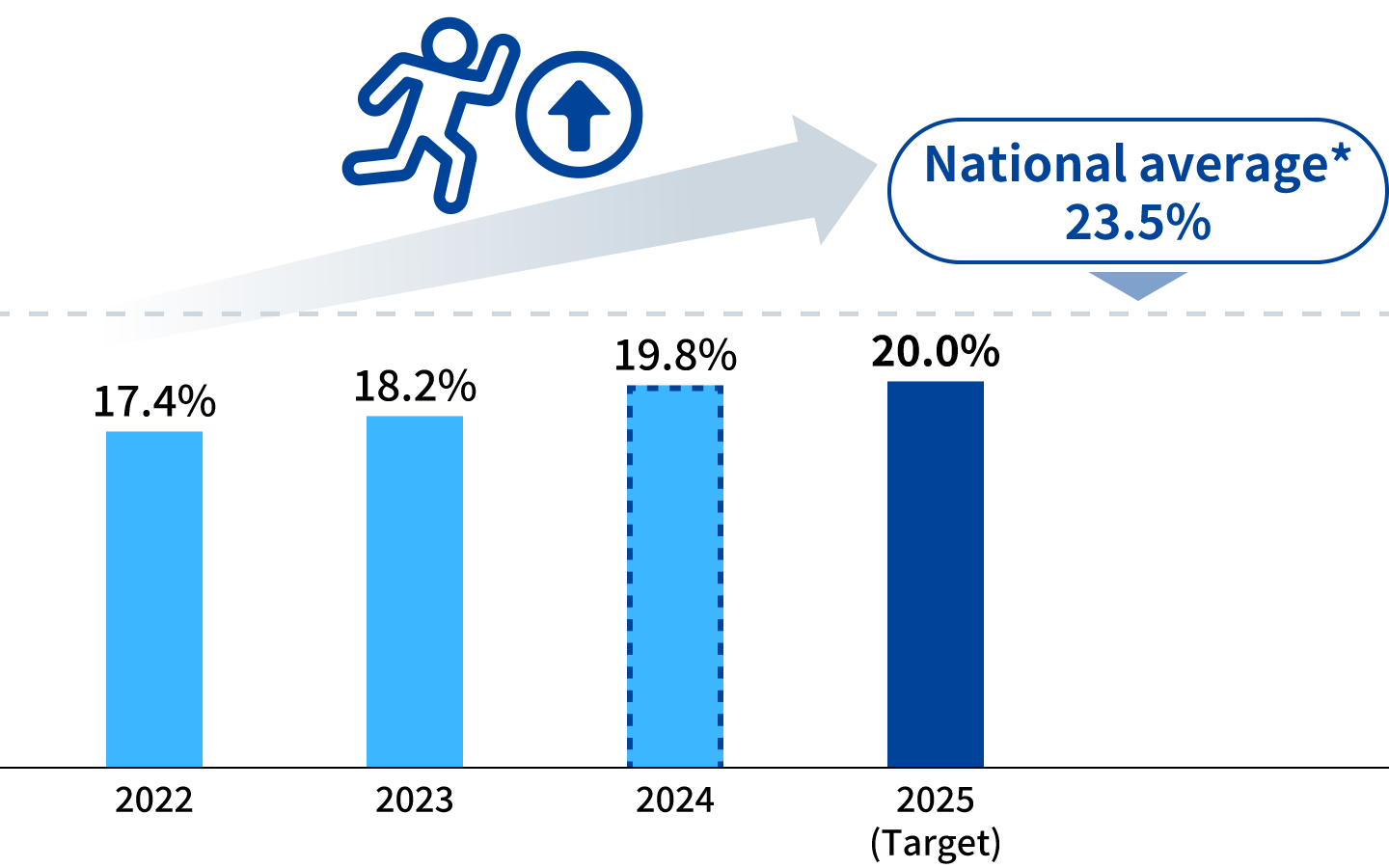
*Percentage of individuals aged 20 to 59 engaging in regular exercise compared to the national average of 32.0% in the 2023 National Health and Nutrition Survey data for individuals aged 20 and older.
Smoking
Percentage of health survey respondents indicating they smoke
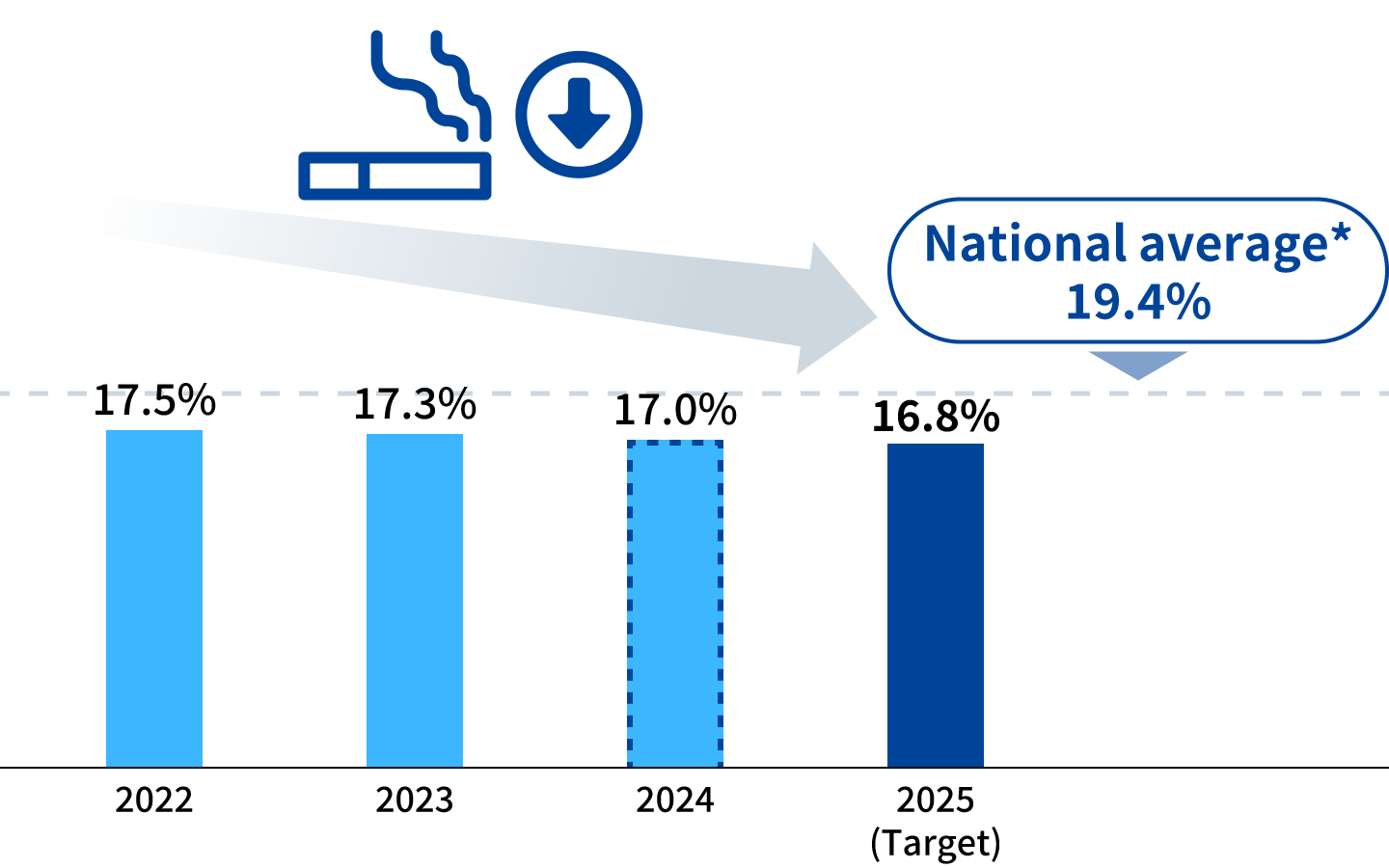
*Percentage of smokers aged 20 to 59 compared to the national average of 15.7% in the 2023 National Health and Nutrition Survey data for individuals aged 20 and older.
| Item | Measurement method | FY2022 | FY2023 | FY2024 | FY2025 (Target) |
|---|---|---|---|---|---|
| Breakfast consumption | Percentage of health survey respondents indicating they eat breakfast 4 days or more per week | 56.2% | 56.0% | 55.6% | 56.0% |
| Sleep quality | Percentage of health survey respondents indicating they have sufficient sleep | 69.5% | 69.0% | 68.6% | 68.8% |
| Liver health | Percentage of health survey respondents indicating they rarely or only occasionally drink alcohol | 87.5% | 88.3% | 87.8% | 88.0% |
*Percentages represent the number of responses meeting the criteria versus the total number of responses.
Job satisfaction and performance indicators
Health initiative outcomes are evaluated and verified using indicators related to job satisfaction and performance.
| Item | Measurement method | FY2022 | FY2023 | FY2024 | FY2025 |
|---|---|---|---|---|---|
| Work engagement | Pulse survey measurement/deviation value (90% response rate) Note: Average value at participating companies: 50 |
48.7 | 50.9 | 50.9 | 51.6 |
| Presenteeism | Based on the University of Tokyo Single-Item Presenteeism Question Note: Companies using pulse surveys (n = 96,000) average: 76.6% |
77.9% | 77.0% | 76.2% | 70.7% |
| Absenteeism | Number of days off work due to injury or illness in one year | 4.3 days | 3.8 days | 3.9 days | 4.8 days |
Mental health initiatives
Pulse surveys to improve the workplace environment and health support
We conduct annual stress checks and regular pulse surveys to monitor conditions at both the employee and organizational level. The results are used to improve the workplace environment and strengthen the individual support provided to employees.
Return to work support
Occupational health staff and Health Management Center staff support employees on mental health leave. A return-to-work program provides additional assistance for a smooth transition back, and health staff offer follow-up care.
Other initiatives
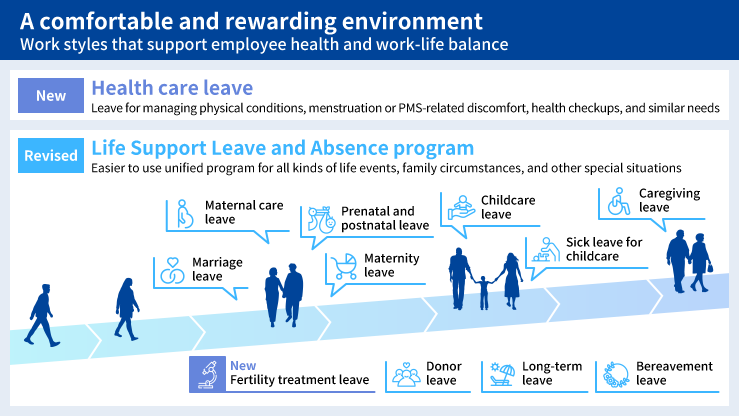
Health care leave program
Health care leave allows up to 12 days per year, including two paid days, which can be taken in 30-minute increments, for recuperation, scheduled hospital visits, medical examinations, and follow-up tests. Menstrual leave is also incorporated into health care leave, which helps eliminate the discomfort sometimes associated with requesting it and enables all employees to use the leave system more readily for health-related purposes.
Life Support Leave and Absence program
Life Support Leave and Absence may be used for personal lifestyle needs, life events, family responsibilities, and child and nursing care, which now includes fertility treatments. The program content has been revised to better respect personal privacy, making leave requests easier to submit, and to support a healthy work-life balance.
Fertility treatment leave is available to all employees, regardless of gender, for up to 12 days per year in 30-minute increments, and up to one year of leave of absence may be taken for treatment. These systems support diverse work styles and help employees raising the next generation maintain a healthy work–life balance, fostering an environment where they can continue working with peace of mind.
Occupational health staff counseling
The Company’s staff of occupational physicians and public health nurses provides readily available consultation services. Employees can contact the service directly about occupational health issues or any issue that they may find difficult to discuss with the company staff.
Health management initiatives